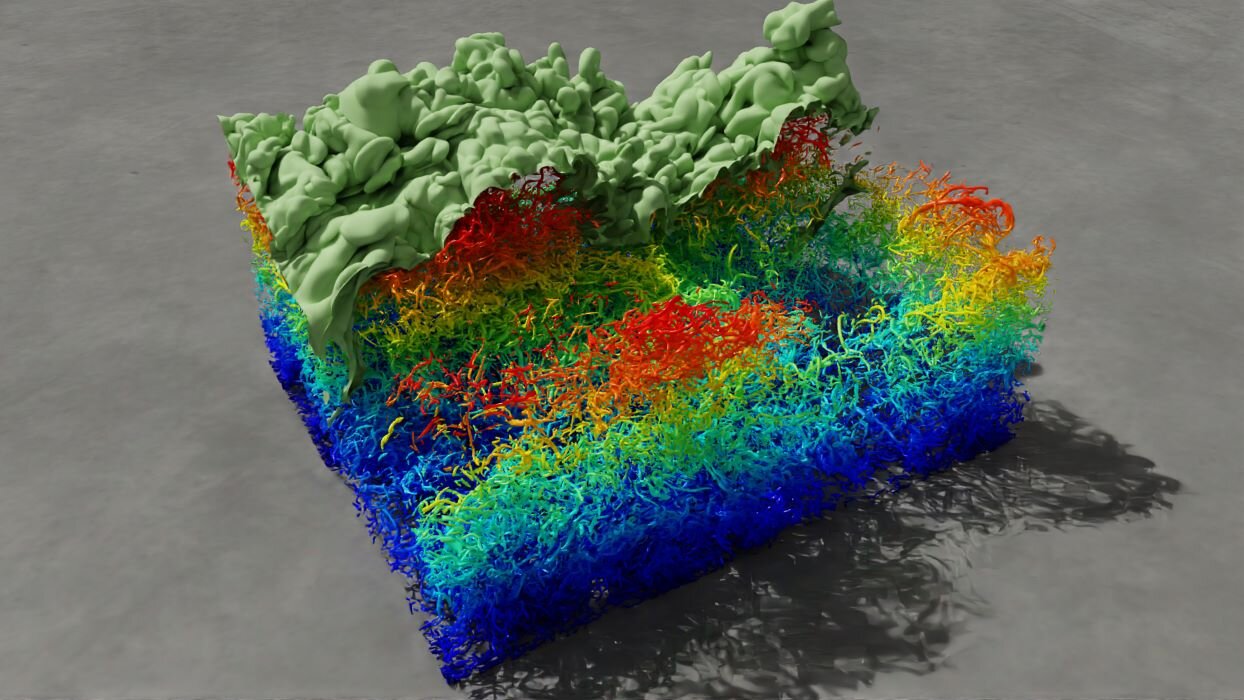
Mori-Zwanzig modeling
Learning finite-memory closures and reduced representations for particle dynamics, boundary-layer transition, and other systems where unresolved scales shape observable behavior.
Applied Mathematics | Computational Physics | LANL
I work on trustworthy AI for simulation, scientific machine learning, reduced-order models, surrogate models, and uncertainty quantification (UQ) for multiphysics simulations.
Research Focus
My work sits at the intersection of turbulence, numerical methods, machine learning, and applied mathematics. The goal is to preserve the physical structure that matters while lowering the cost of prediction and analysis.
Learning finite-memory closures and reduced representations for particle dynamics, boundary-layer transition, and other systems where unresolved scales shape observable behavior.
Using particle-based descriptions, smoothed particle hydrodynamics, and large-eddy simulation ideas to study turbulence from a physically interpretable viewpoint.
Building physics-informed neural models, differentiable programs, and data-driven methods that respect conservation, topology, and multiscale structure.
Selected Publications
These publications highlight the page’s core theme: data-driven tools that remain connected to physical modeling, numerical analysis, and interpretable flow dynamics.
Surrogate modeling for particle trajectories in turbulence, aimed at reproducing rich statistical behavior at lower computational cost.
A physics-informed approach to large-eddy simulation for high-Reynolds-number homogeneous isotropic turbulence.
A hierarchy of parameterized reduced Lagrangian models for turbulent flows, using physical structure through SPH.
Reduced-order modeling and modal decomposition for sparse sensor measurements and laminar-turbulent transition analysis.
Background
My path includes graduate training at the University of Arizona, a LANL postdoctoral fellowship, and a June 2026 conversion to Scientist II at Los Alamos National Laboratory. My research interests span reduced-order modeling, turbulence, plasma physics, Koopman analysis, and differentiable programming.
June 2026-Present
Scientist II in Trustworthy AI for Simulation, working on computational physics, turbulent flows, reduced-order modeling, and scientific machine learning.
2024-June 2026
Harold Agnew National Security Postdoctoral Fellow and CNLS Fellow in Daniel Livescu’s group before conversion to Scientist II.
2018-2023
PhD in Applied Mathematics. Dissertation: Reduced Lagrangian and Mori-Zwanzig models: Applications to Turbulent Flows.
Connect
The page is designed around a single primary action: reviewing the research record. LinkedIn is available for professional contact and updates.